This post covers Commercial Integrator’s 2024 AV-over-IP Deep Dive, “Chronicling the AV-over-IP Revolution.” Our Director of Sales and Marketing, Dalton Parker, was one of the industry contributors.
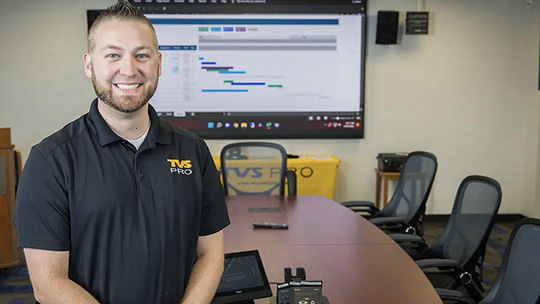
Last year we wrote about AV over IP vs. traditional AV and which approach makes the most sense. This year, Commercial Integrator asked the whole industry the same question. Their 2024 AV-over-IP Deep Dive combines a survey of integrators with interviews with industry thought leaders: Sean Wargo of AVIXA, Marty Fornelli of Diversified, John Richards of AVI-SPL, Lincoln King-Cliby of ControlWorks Consulting, and our own Dalton Parker.
The findings show an industry in the middle of a major transition.
AV-over-IP Is Becoming the Default
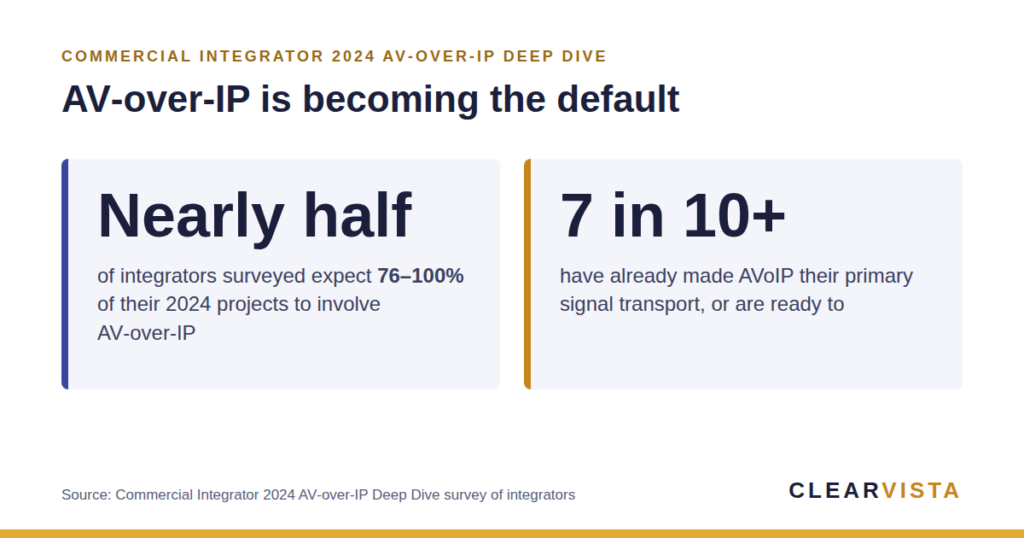
According to CI’s research, nearly half of surveyed integrators expect 76% to 100% of their 2024 projects to involve AV-over-IP. More than seven in ten say they’ve already made AVoIP their primary signal-transport approach or are ready to.
The report compares this to the way VoIP replaced traditional phone systems in the corporate world. It didn’t happen overnight, but once the network could handle it, the benefits were too great to ignore. AV is following the same path.
Adoption Still Varies Widely
The survey also found wide variation in how much integrators actually use AVoIP today. Some firms are all-in, while others still rely mainly on traditional matrix switching and point-to-point cabling. For organizations buying AV, that means experience varies a lot from one integrator to the next.
What’s Driving It, and What’s Holding It Back
The Deep Dive looks at why AVoIP is growing and where the concerns remain. The benefits most organizations care about:
- Scalability. Adding a display, room, or source is a network connection instead of a bigger matrix switcher.
- Flexibility. Any source can go to any display, across a room, a building, or a campus.
- Simpler infrastructure. Standard network cabling and switches replace specialized, distance-limited cables.
The concerns are just as real. They include network readiness, coordination with IT, bandwidth and latency, and the number of competing approaches and protocols on the market. The report asks directly whether all those options help or hinder integrators, and that question matters for anyone who wants a system that will still be supported years from now.
What This Means for Your Organization
If you’re planning a new AV project or an upgrade, AV-over-IP should be part of the conversation. A few things to keep in mind:
- Bring IT in early. Your AV system will run on your network, so your IT team should help plan it from the start.
- Choose the platform for the application. The right AVoIP approach for a boardroom may not suit a command center or a campus-wide signage system.
- Plan for growth. One of AVoIP’s biggest advantages is that you can expand it, so design with the next phase in mind.
At TVS Pro, we’ve designed and installed both traditional and networked AV systems for over 70 years of technology change. We help our clients choose the right approach for their space, their network, and their goals.
Want the full findings? Download the 2024 AV-over-IP Deep Dive from Commercial Integrator. Ready to talk about your next project? Contact our team.
Our AV-over-IP Deep Dive Series
Each year, ClearVista (formerly TVS Pro) has contributed to Commercial Integrator’s AV-over-IP Deep Dive. Follow how the industry has changed:
- 2024: Chronicling the AV-over-IP Revolution (you are here)
- 2025: AV-over-IP and the Future of Pro AV
- 2026: AVoIP Grows Up: What Operational Maturity Means for Your AV


0 Comments